
How to use this roadmap
Use this roadmap backwards from your current readiness. If your basics are weak, the 90-day structure matters even if you have more time. If your basics are strong but mock scores fluctuate, the 60-day and 30-day sections may be more relevant. A preparation plan should not be judged by how ambitious it looks. It should be judged by whether it produces better decisions in practice.
Begin with a baseline: one sectional or mock-style attempt, plus a sober review. Identify the weakest section, the most repeated error type and the topic that creates the most time loss. Then build the week around those findings while keeping all sections alive. CAT generally punishes neglect. A strong QA student can still lose ground if VARC accuracy collapses or DILR selection remains random.
90-day, 60-day and 30-day phases
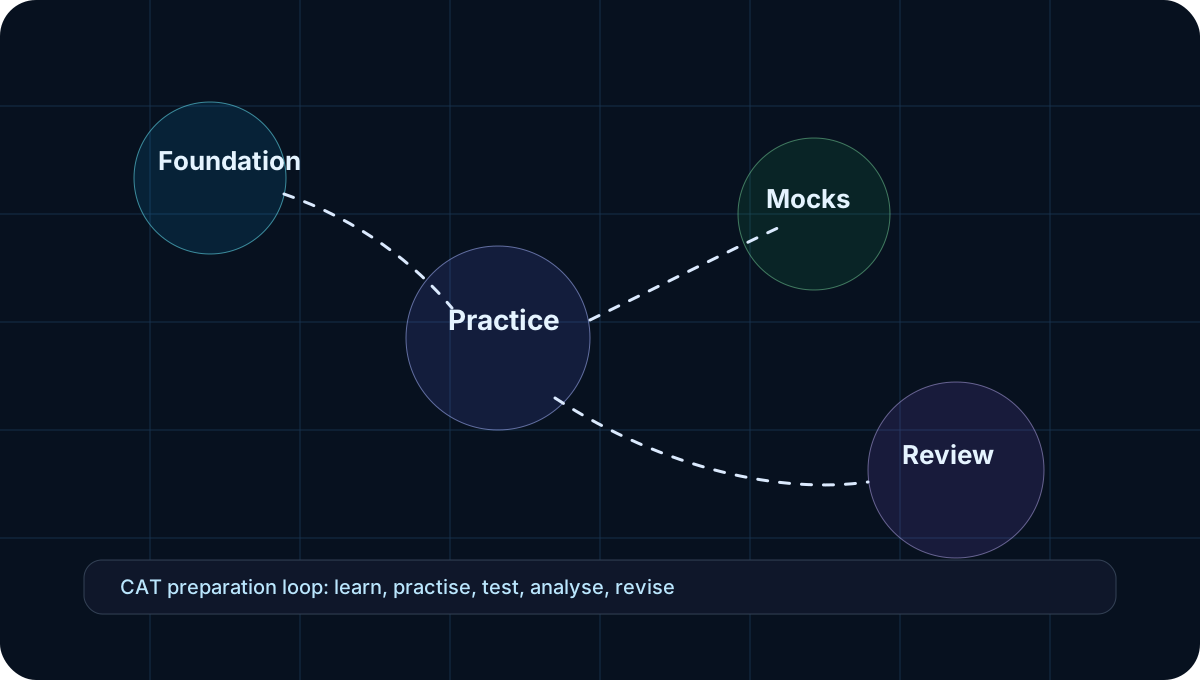
The 90-day phase is for coverage and repair. Build arithmetic, algebra and geometry foundations, rotate DILR set families and develop a reading habit for VARC. Begin light mock exposure so timing problems appear early. The 60-day phase should shift toward mixed practice and more disciplined analysis. By now, you should know which errors repeat. The 30-day phase is for consolidation. Avoid adding too many new sources unless a specific gap demands it.
| Phase | Main goal | Work style |
|---|---|---|
| 90-day phase | Build coverage, repair basics, start light mocks | Foundation study, sectional practice, early diagnostics |
| 60-day phase | Increase mixed practice and review repeated errors | Sectional tests, timed DILR sets, QA mixed blocks, VARC evidence review |
| 30-day phase | Stabilise strategy and reduce new material | Mocks, revision sheets, error notebook, attempt plan |
| Final week | Protect confidence and recall | Light revision, selected review, sleep and exam-day logistics from official sources |
Daily and weekly schedule
A useful daily schedule has one primary block and one review block. The primary block may be QA concept work, a DILR timed set session or VARC passage practice. The review block should be shorter but non-negotiable. It converts mistakes into next actions. Without review, a student may spend many hours solving while repeating the same error.
A balanced week can include two QA sessions, two DILR sessions, two VARC sessions, one mock or sectional test and one deep analysis block. The exact balance should respond to evidence. If QA is strong but DILR is unstable, shift an extra block to DILR set selection. If VARC accuracy is low, add close-option review instead of merely reading more. The schedule should be realistic enough to survive work, college or family responsibilities.
Weak-area management
Weak areas should be made smaller, not feared. Break a weak section into causes. In QA, the issue may be formulas, calculation, method choice or skipping. In DILR, it may be set selection, representation, condition tracking or arithmetic. In VARC, it may be passage stamina, inference, tone or close options. Once the cause is named, the repair becomes manageable.
Use a two-week repair cycle. Week one focuses on targeted study and untimed correction. Week two introduces timed mixed practice. At the end of the cycle, check whether the error appears again in a mock. If it does, the repair was incomplete. If it reduces, keep the topic in light revision and move to the next bottleneck.
Common strategy mistakes
The first mistake is building a schedule that looks impressive but cannot be followed. Consistency beats heroic planning. The second mistake is changing strategy after every mock. A single score can mislead; repeated patterns matter more. The third mistake is ignoring strong sections. Strength decays when it is not maintained, especially in VARC reading and DILR selection.
Another mistake is adding new resources in the final stretch because of anxiety. New material can help only when it solves a specific gap. Otherwise it crowds out revision. In the final week, the goal is not to become a different student. The goal is to carry the best version of your existing preparation into the paper.
CAT strategy FAQ
Can I prepare for CAT in 90 days?
A 90-day plan can be productive if basics exist and daily work is consistent. It should emphasise high-yield gaps, mock analysis and disciplined revision rather than trying to consume every resource.
What should I do in the last 30 days?
Reduce new resources. Focus on mocks, error notebooks, revision sheets and a stable section strategy.
How do I balance the three CAT sections?
Keep all sections active weekly. Give extra blocks to weak areas, but do not let a strong section go cold.
Practice next
Put the CAT roadmap into practice.
Start with targeted practice, then use mocks to confirm whether the plan is working under time pressure.