
How to use this QA guide
Begin by identifying what kind of QA problem you have. Some students lack basic concepts; they need slower foundation work. Some know the concepts but choose long methods; they need alternate-solution review. Some solve accurately at home but make mistakes in mocks; they need timed mixed practice. The same chapter can require different treatment for different students, so do not copy another student's schedule blindly.
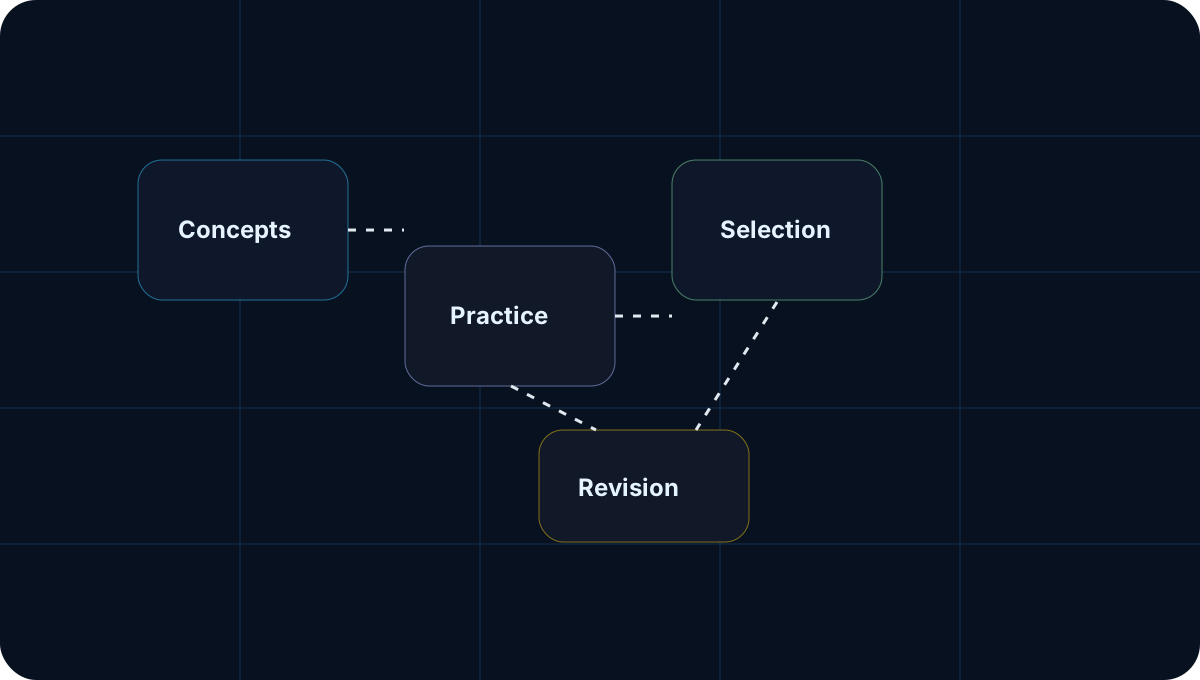
For every topic, create three layers of practice. The first layer is concept examples where you learn the method. The second layer is topic practice where you solve enough questions to see common variations. The third layer is mixed timed practice where the topic is no longer announced. CAT generally rewards the third layer, but the third layer becomes frustrating if the first two are weak.
Major QA areas
Arithmetic is often the most connected part of QA. Percentages flow into profit-loss, ratios support mixtures and averages, and time-speed-distance can mix with work-rate thinking. Algebra builds symbolic control: equations, inequalities, functions and logs require careful transformation. Geometry rewards memory of theorems, but only when the diagram is read correctly. Number system and modern math are often less about long calculation and more about recognising structure.
| Area | Typical topics | Preparation focus |
|---|---|---|
| Arithmetic | Percentages, ratios, averages, profit-loss, interest, time-work, time-speed-distance, mixtures | Build connected thinking; arithmetic ideas often combine inside one question. |
| Algebra | Equations, inequalities, functions, logs, sequences, graphs | Practise manipulation, substitution and option testing instead of only formula recall. |
| Geometry | Triangles, circles, quadrilaterals, coordinate geometry, mensuration | Draw disciplined diagrams and revise theorem triggers with examples. |
| Number System | Divisibility, remainders, factors, factorials, bases | Train pattern recognition and modular thinking with small examples first. |
| Modern Math | Permutation-combination, probability, set theory | Write cases carefully; avoid counting the same case twice. |
Practice sequencing
A sensible sequence is foundation, variation, mixed practice and mock repair. In the foundation phase, write formulas and solve direct examples until the idea is clear. In the variation phase, solve questions that change wording, introduce constraints or combine two ideas. In mixed practice, remove chapter labels. In mock repair, use actual mistakes to decide what returns to revision.
For example, a student revising percentages should not stop after basic increase-decrease questions. The next step is to connect percentages with ratio comparison, compound change, profit-loss and data interpretation. Similarly, a geometry student should not merely memorise circle theorems; they should practise when a tangent, chord or angle relation is hidden inside a diagram. QA grows when topics start talking to each other.
Revision and error review
Keep a QA error notebook with four columns: question idea, error type, better method and retest date. Error type matters. A calculation slip needs slower writing and estimation checks. A concept gap needs re-learning. A long method needs alternate-solution review. A poor attempt choice needs skip discipline. Without this classification, every error looks the same and revision becomes vague.
Before a mock, revise compact sheets: arithmetic conversions, algebra identities, geometry triggers, common number-system patterns and counting principles. After a mock, do not revise the entire syllabus. First review wrong and time-heavy questions, then choose two or three repair topics. The aim is to make the next mock more informed, not to punish yourself with random extra solving.
Common QA mistakes
The first mistake is solving only from one chapter at a time. Chapter practice builds confidence, but exam questions arrive mixed. The second mistake is worshipping speed before accuracy. Fast wrong answers do not help. The third mistake is refusing to skip. CAT QA often contains questions that are solvable but not worth your time during a first pass. Skipping is not weakness; it is part of score management.
Another common mistake is using the same method for every question. Some questions are meant for direct calculation, some for options, some for substitution and some for estimation. During review, ask whether the official or shorter solution used a different entry point. That question teaches more than another round of similar practice.
CAT QA FAQ
What is the best way to improve CAT QA accuracy?
Separate each error into concept gap, calculation slip, wrong method, poor question selection or time pressure. Accuracy improves when the fix matches the cause.
Should I memorise formulas for QA?
Formula recall helps, but CAT QA generally tests whether you know when to use a formula and when to switch to estimation, substitution or elimination.
How should I revise arithmetic?
Revise arithmetic through mixed drills. Percentages, ratios, averages and time-based questions should be connected because CAT-style questions often blend them.
Practice next
Convert QA revision into timed solving.
Use topic practice to repair concepts, then use mocks to test selection and timing. The best QA plan is the one that changes after honest review.