How to use this resource hub
Start by treating this page as a navigation desk. If you are new to CAT, read the syllabus guide before opening section-specific pages. If you already know the broad syllabus, move directly to the section where your score is least reliable. A student who loses marks because of calculation errors should not spend the week reading only VARC advice. A student who solves QA well but panics in DILR should build set-selection discipline before increasing the number of mock tests.
A useful way to work through the hub is to read one guide with a notebook open. Write down three things: what you already do well, what fails under time pressure and what you will practise before the next mock. This keeps the page from becoming passive reading. CAT generally rewards adaptable reasoning, so the aim is not to memorise page text; the aim is to use the page to choose the next concrete practice block.
A practical CAT preparation structure
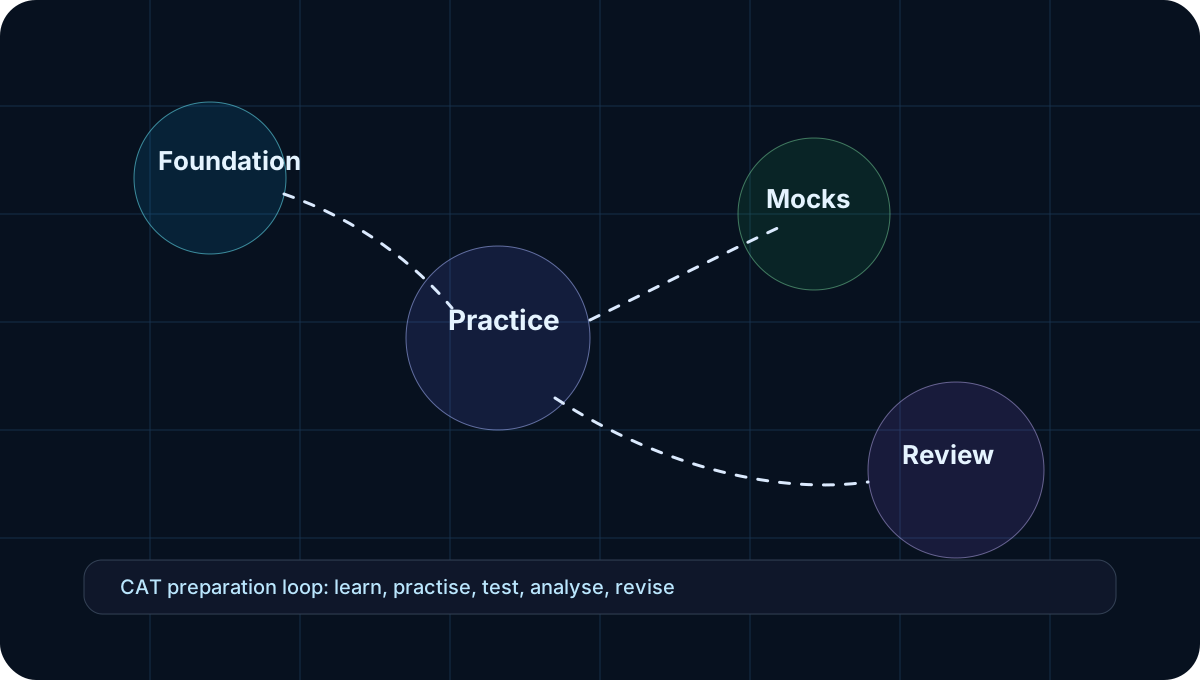
The most dependable structure is a loop: learn, practise, test, analyse and revise. Learning without timed solving remains fragile. Timed solving without analysis turns into repetition. Analysis without revision becomes a list of regrets. The loop works because each stage feeds the next one. When a mock exposes weak arithmetic, the next QA block should target that exact arithmetic family. When a DILR set collapses because the table was poorly drawn, the next set session should focus on representation, not just difficulty.
Use the hub to keep that loop visible. The section pages explain what to practise, the mock page explains how to interpret scorecards, the PYQ page explains how to use older questions without over-reading them, and the preparation strategy page helps you distribute effort across 90-day, 60-day and 30-day windows. None of these pages claims that preparation is linear. Most students improve in waves: one section rises, another slips, and the weekly plan must adjust.
How the three CAT sections connect
CAT generally tests three broad skill families. VARC asks whether you can read accurately, understand an argument and reject options that feel attractive but lack support. DILR asks whether you can transform a messy situation into a structured representation. QA asks whether you can choose a mathematical method, execute it cleanly and decide when a question is not worth the time. These are different skills, but they share a common habit: disciplined review.
| Resource | Use it for | Avoid this mistake |
|---|---|---|
| CAT Syllabus | Understand the broad topic map before deciding what to study this week. | Treating the syllabus as a guarantee that every listed idea will appear in a predictable way. |
| Quantitative Aptitude | Plan arithmetic, algebra, geometry, number system and modern math practice. | Jumping into advanced questions before method selection and calculation discipline are stable. |
| DILR | Build set-family recognition and a repeatable set-selection process. | Measuring progress only by the number of sets attempted instead of the quality of review. |
| VARC | Improve passage reading, verbal logic and close-option elimination. | Reading more essays but not reviewing why the chosen option was unsupported. |
| Mock Strategy Guide | Convert mock scorecards into revision decisions. | Taking another mock immediately after a bad mock without analysing the previous one. |
| PYQ Strategy Guide | Study question framing, topic familiarity and realistic difficulty. | Assuming older questions predict exact future questions or section composition. |
Common preparation mistakes
The first common mistake is collecting resources faster than using them. A student may save ten formula sheets, several reading lists and many mock PDFs, but the score improves only when errors are traced and corrected. The second mistake is preparing sections in isolation. CAT performance is affected by energy and time allocation. A difficult DILR section can disturb QA; a poor start in VARC can lead to rushed judgement later. Mock tests are useful because they expose these interactions.
The third mistake is confusing comfort with readiness. Untimed topic practice may feel smooth, but exam pressure changes method selection. Use easy drills to build foundations, then move to mixed timed sets where the topic is not announced. The fourth mistake is overreacting to one score. A single mock can be affected by difficulty, mood or unfamiliar set types. Look for repeated patterns across several attempts before changing the entire plan.
A weekly study loop
A balanced week can include two QA blocks, two DILR sessions, two VARC sessions, one mock or sectional test, and one analysis block. The exact mix should depend on your current weakness. For QA, one block can be concept repair and one can be mixed timed practice. For DILR, one block can focus on a set family such as arrangements or tables, while the other should be timed and mixed. For VARC, combine reading comprehension with verbal ability review so that sentence-ordering and summary errors do not get ignored.
End the week with a short audit: Which mistakes repeated? Which topic needs revision? Which question should have been skipped? Which answer was changed without evidence? These questions make the next week sharper. Preparation is not about being busy; it is about making the next practice session more informed than the last one.
CAT resources FAQ
Can I use this CAT resource hub as a complete study plan?
Use it as a planning layer, not as a replacement for solving. The hub tells you what to study, how to order it and how to review it. The score improvement comes when each page is paired with timed practice, error review and mock analysis.
Should I read every CAT page before starting practice?
No. Read the hub and syllabus first, then move to the weakest section. Once you know the structure, alternate between section practice and review. Reading strategy pages without solving questions creates a false feeling of preparation.
How often should I return to these CAT resources?
Return after every few mocks or after a visible performance dip. A good resource page is most useful when you bring real mistakes to it: a repeated arithmetic error, a DILR representation failure or a VARC close-option trap.
Practice next
Turn the resource map into timed CAT practice.
Use the practice library for section work, then use mock tests to see whether your plan is holding under time pressure. A good week ends with fewer unknown weaknesses than it started with.