How to use this syllabus guide
Use the syllabus as a planning document. If a topic appears here, ask three questions: do I know the basic idea, can I solve it without being told the topic, and can I still solve it when it appears inside a mixed mock? Many students stop after the first question. CAT generally rewards the second and third. Averages may look easy in isolation, but they become harder when mixed with ratios, percentages and time pressure. Reading comprehension may feel familiar, but close options expose whether you actually understood the author's scope.
Before each week begins, choose a small number of syllabus targets. A good target is specific: revise profit-loss applications, solve three arrangement sets, review inference errors in two RC passages. A weak target is vague: improve QA, do DILR, read more. The syllabus becomes useful only when it narrows the next action.
Syllabus overview
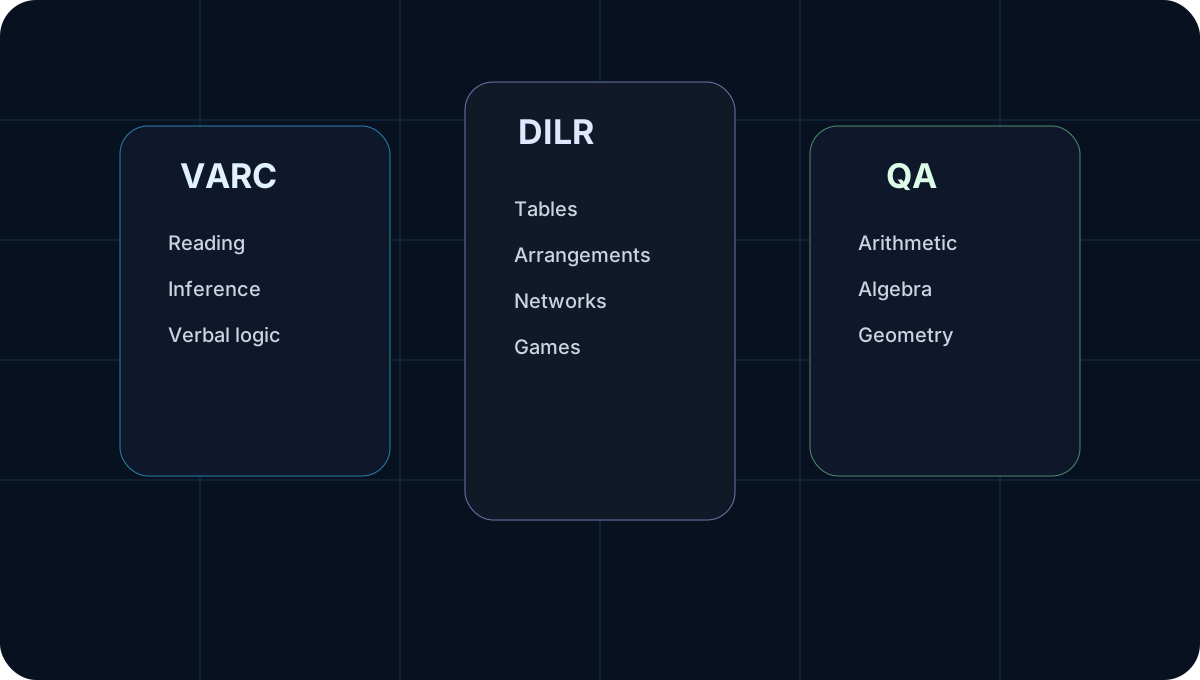
VARC generally contains reading-heavy work and verbal reasoning. Reading comprehension should be treated as the centre of the section because it trains evidence, tone and inference. Para jumbles, para summaries and odd sentence questions test paragraph architecture: opening idea, continuity, contrast, cause and conclusion. Vocabulary matters most when it is understood in context, not as isolated word memorisation.
DILR is less like a fixed chapter list and more like a library of set engines. Arrangements, games, tables, distributions and charts can appear with new stories, but the underlying work is similar: identify variables, record constraints, choose a representation and avoid over-solving. QA covers arithmetic, algebra, geometry, number system and modern math. The section tests both knowledge and restraint. A student who knows a formula but spends six minutes on a low-return question has not yet built CAT-level judgement.
Topic-wise preparation map
| Section | Topic families | Preparation focus |
|---|---|---|
| VARC | Reading comprehension, para jumbles, para summary, odd sentence, critical reading, vocabulary in context | Daily reading, passage evidence, close-option review |
| DILR | Arrangements, tables, charts, games and tournaments, routes, networks, selection and distribution | Set selection, representation, condition tracking |
| QA | Arithmetic, algebra, geometry, number system, modern math | Concept clarity, method choice, calculation discipline |
Do not read this table as a prediction of exact future distribution. Use it to prevent blind spots. If your mock score is held back by one repeated weakness, the table helps you locate the correct page and build a focused repair session.
How to prioritise topics
Priority should be based on three factors: frequency of practice errors, foundational importance and time needed for repair. Arithmetic is usually foundational because percentages, ratios and averages appear inside many quantitative contexts. In DILR, representation is foundational because a clean table or diagram can make an unfamiliar set solvable. In VARC, passage evidence is foundational because unsupported inference errors repeat across RC and verbal ability.
After basics are in place, shift from chapter completion to mixed practice. Mixed practice is uncomfortable because it removes topic labels, but that is exactly why it matters. CAT questions rarely announce the best method. A student must decide whether to calculate, estimate, substitute, eliminate, draw a case table or skip. The syllabus gives the raw material; mocks and PYQs test whether the raw material is available under pressure.
Common mistakes while using the syllabus
The first mistake is trying to finish every topic once before taking mocks. Early mocks are diagnostic; they show whether your study is exam-facing. The second mistake is building a beautiful topic checklist without an error notebook. If the same type of RC inference error appears five times, the syllabus has already told you what to fix. The third mistake is spending equal time on every topic. Equal time feels fair, but preparation should respond to evidence.
Another common mistake is avoiding weak areas until late. Weak areas become expensive when they are postponed because they begin to affect confidence. If DILR representation is weak, even an easy set can feel hostile. If number-system basics are weak, a solvable remainder question becomes a time sink. Use this syllabus to identify small repairs early, before they become mock-day patterns.
CAT syllabus FAQ
Is the CAT syllabus officially fixed topic by topic?
Students should treat the CAT syllabus as a practical preparation map rather than a school-style chapter list. Official notifications should always be checked for administrative details, but preparation is best organised around VARC, DILR and QA skill families.
Which section should I begin with?
Begin with the section where your basics are weakest, but keep all three sections active every week. CAT preparation becomes risky when one section is ignored for too long and then has to be revived under mock pressure.
How should I revise the syllabus?
Revise through mistakes, not only notes. A formula sheet, a DILR representation notebook and a VARC close-option log are more useful than rereading the same topic list repeatedly.
Practice next
Move from syllabus reading to timed practice.
Open the CAT practice library after choosing a small set of topics. Then use mock analysis to check whether those topics are improving under time pressure.