How to use this PYQ guide
Use this guide to keep PYQ work purposeful. Before solving, decide whether the goal is orientation, topic review, timed rehearsal or final revision. A question can teach different things depending on when you solve it. Early in preparation, an old QA question may simply reveal that your arithmetic basics are weak. Later, the same question may reveal that you used a long method when a shorter comparison would have worked.
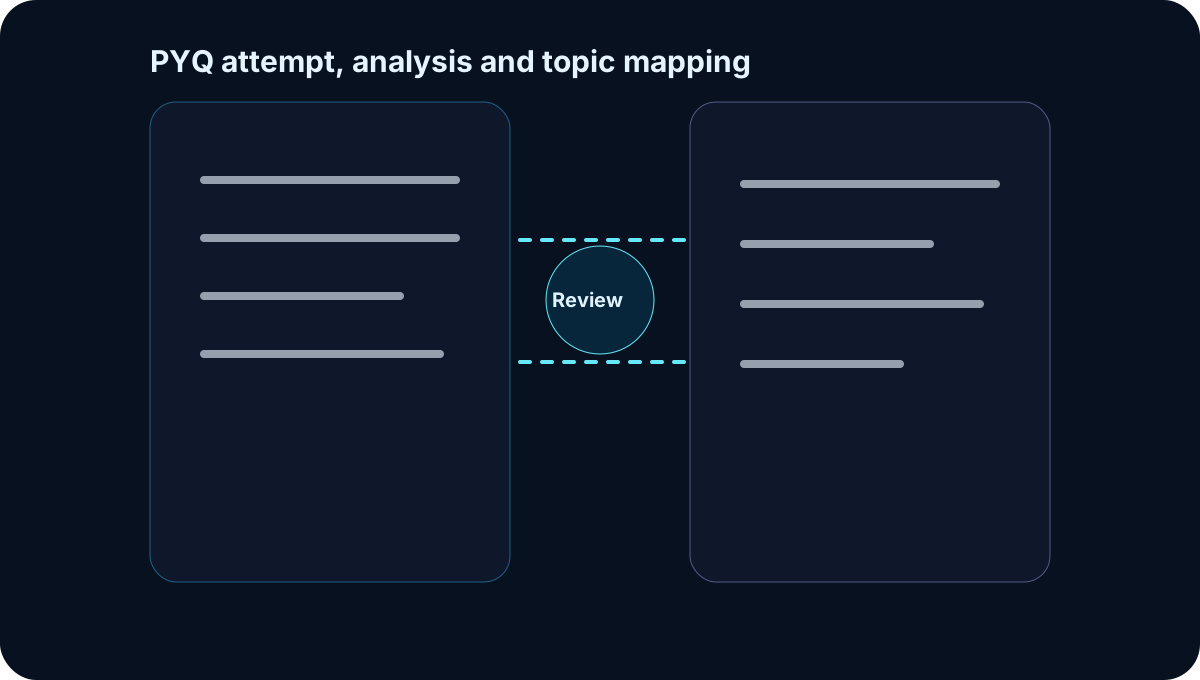
Do not consume PYQs passively. After every block, tag each error by section, topic and cause. In VARC, note whether the wrong option added outside information or distorted tone. In DILR, note whether the set failed because of selection or representation. In QA, note whether the method was conceptually wrong, too long or poorly executed. This tagging turns old papers into a revision map.
Why PYQs matter
PYQs expose the style of demand. They show that CAT generally tests flexible reasoning rather than mechanical repetition. A DILR set may use an unfamiliar story, but the underlying work may be a table, distribution or arrangement. A VARC passage may come from an unfamiliar subject, but the question may still test inference, tone or central idea. A QA question may be from a known chapter but require option use or estimation.
Previous year papers also teach restraint. Some questions are worth solving immediately; others should be marked and revisited. When you practise with old questions under a timer, you learn that knowing a concept is different from selecting it at the right moment. This is why PYQs should sit between topic practice and mocks, not replace either.
They also help students calibrate language. CAT-style questions often use careful wording: except, must be true, can be inferred, best captures, or according to the passage. Missing one phrase can change the task. Reviewing old papers slowly trains this attention to wording, which is useful across VARC, DILR and QA.
Timed solving and review
Start with small timed blocks. For example, attempt a group of QA questions without chapter labels, or solve one DILR set with a strict exit rule. Review the block before increasing volume. Later, attempt larger blocks or full paper-style sessions if available in your preparation system. Always review timing along with correctness.
| Stage | How to use PYQs | Caution |
|---|---|---|
| Before syllabus coverage | Use selected questions for orientation | Do not judge your entire ability from early exposure. |
| During topic preparation | Connect old questions to QA, DILR and VARC topic families | Do not solve only familiar chapters. |
| During mock phase | Use full or sectional timed blocks | Do not convert PYQs into prediction charts. |
| During final revision | Review marked errors and repeated traps | Do not start a large new PYQ backlog too late. |
What not to infer blindly
Do not infer exact future pattern from a small set of old papers. CAT can change emphasis, difficulty and section feel. PYQs are excellent for pattern awareness, but weak as prediction machines. A topic that appeared often in one period should not become your only focus. A topic that appeared less visibly should not be ignored if it is foundational.
Also avoid reading solutions too quickly. A clean solution can hide the difficulty of discovering the approach. Try to reconstruct the entry point: What clue suggested this method? Which condition mattered first? Which option could be eliminated? This review builds exam judgement better than simply copying the final method.
Common PYQ mistakes
The first mistake is solving PYQs topic-wise forever. That can help at first, but eventually you need mixed blocks where the topic is not announced. The second mistake is treating PYQ accuracy as final proof of readiness. If you have seen the questions before or remember the method, the score may be inflated. The third mistake is ignoring unattempted questions. A skipped but doable question is a selection issue and deserves review.
Another mistake is turning PYQs into prediction lists. It is tempting to count topics and declare what will appear, but that can narrow preparation dangerously. Use PYQs to understand how CAT generally asks, not to avoid broader practice.
CAT PYQ FAQ
Should I solve CAT PYQs before mocks?
Use a few PYQs early for orientation, then mix them with mocks and section practice. Full PYQ work is most useful after basic topics are familiar.
Can PYQs predict the next CAT paper?
PYQs can reveal recurring skills and topic families, but they should not be treated as exact prediction material.
How should I revise from PYQs?
Tag every error by topic and error type. Then revise the source topic and solve similar fresh questions.
Practice next
Connect PYQs with active CAT practice.
Use old-paper insights to choose what to practise next, then validate the repair in mocks.