How to use this VARC guide
Use this page as a review lens. After every RC passage or verbal ability set, write down why the correct answer is correct and why the tempting wrong answer is wrong. This habit is more powerful than counting how many passages you solved. VARC errors often repeat because the student accepts an option that sounds intelligent but changes the author's claim, adds an unsupported conclusion or uses extreme language.
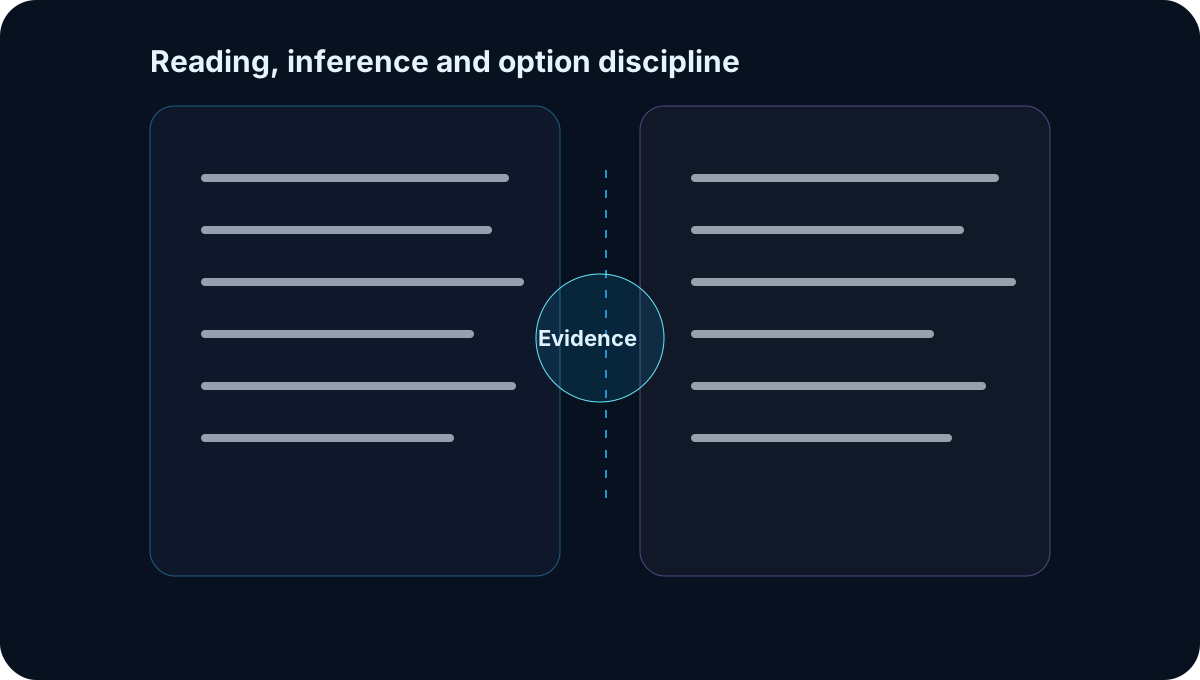
For daily work, combine reading with question review. Reading long-form essays, editorials and analytical writing can improve comfort with dense prose, but CAT-style performance depends on evidence. When you answer a question, point to the line, paragraph role or argument shift that supports your choice. If you cannot defend the answer, treat it as a learning moment even if the answer happened to be correct.
Reading comprehension
Reading comprehension generally tests main idea, inference, tone, author's purpose, detail recognition and logical connection. A good RC attempt begins before the questions. While reading, notice what each paragraph does. Does it introduce a problem, present evidence, challenge a view, explain a theory or draw a conclusion? This paragraph-role awareness prevents you from treating the passage as a list of facts.
When options are close, compare scope. One option may be true in a narrow part of the passage but fail to capture the main idea. Another may sound sophisticated but add a claim the author never made. A third may use extreme wording where the passage is cautious. Review should focus on these differences. The goal is not to become a faster reader at any cost; it is to become a more controlled reader under time pressure.
Verbal ability
Verbal ability questions reward structure. Para jumbles require opening ideas, pronoun links, contrast markers and logical progression. Para summaries require the central argument without distortion. Odd sentence questions require identifying the sentence that breaks the developing paragraph. These are not purely grammar questions. They are coherence questions.
| Area | What it tests | Review habit |
|---|---|---|
| Reading comprehension | Main idea, inference, tone, purpose, detail, strengthen or weaken | Justify every answer with passage evidence. |
| Para jumbles | Opening sentence, pronoun links, contrast, idea progression | Look for paragraph architecture, not only repeated keywords. |
| Para summary | Central argument, scope, author's purpose | Reject options that add claims or shrink the passage unfairly. |
| Odd sentence | Logical continuity, sentence function, topic drift | Find the sentence that breaks the argument, not the one with unfamiliar words. |
| Critical reading | Assumptions, conclusions, evidence, contrast | Slow review matters more than fast guessing. |
Reading habits and review
Build reading habits deliberately. Read subjects that are not always comfortable: economics, philosophy, science writing, social commentary, history and business analysis. While reading, summarise the argument in one sentence. Then ask whether the author is explaining, criticising, comparing or defending. This makes RC review more natural because you already think in terms of argument structure.
A useful VARC notebook has examples of close options. Write the wrong option, the reason it was tempting and the exact reason it failed. Over time you will see patterns: extreme wording, reversed causality, partial truth, outside knowledge and tone mismatch. These patterns are the real syllabus of VARC accuracy.
Common VARC mistakes
The first mistake is over-relying on instinct. Instinct can help with speed, but it must be trained by evidence. The second mistake is changing answers without a reason. If you change an option, write the evidence that forced the change. The third mistake is treating vocabulary as memorisation only. CAT generally tests words in context, author attitude and sentence function more than isolated definitions.
Another mistake is avoiding review because VARC feels subjective. While some close calls are difficult, most errors have a traceable reason. The passage supports one claim and not another. The paragraph needs one order and not another. A summary keeps the central idea while another option exaggerates it. Review makes those reasons visible.
CAT VARC FAQ
How do I improve CAT reading comprehension?
Read regularly, but always review with passage evidence. RC improves when reading and answer justification are trained together.
Are para jumbles grammar questions?
Not mainly. Grammar helps, but para jumbles usually test coherence, transitions and paragraph architecture.
How should I analyse VARC mistakes?
Separate errors into misread passage, unsupported inference, close-option confusion, vocabulary in context and rushing. Then revise the reason, not just the answer.
Practice next
Turn VARC reading into answer discipline.
Use CAT practice for passages and verbal ability, then review every close option before the next mock.